Why Plus-Size Workout Jackets Pull Across the Back - and What to Look For Instead
Quick Answer: Back pulling is an armhole and back-width problem, not a size problem. Most graded patterns increase the chest and waist much faster than they increase the cross-back measurement and the armhole depth, so going up a size makes the jacket loose everywhere except the exact place it binds. Look for raglan or drop-shoulder construction, a center back seam or pleat, and four-way stretch - and measure your cross-back, not just your bust.
If you have ever bought a jacket two sizes up purely to be able to reach forward, this is the article explaining why that happened.
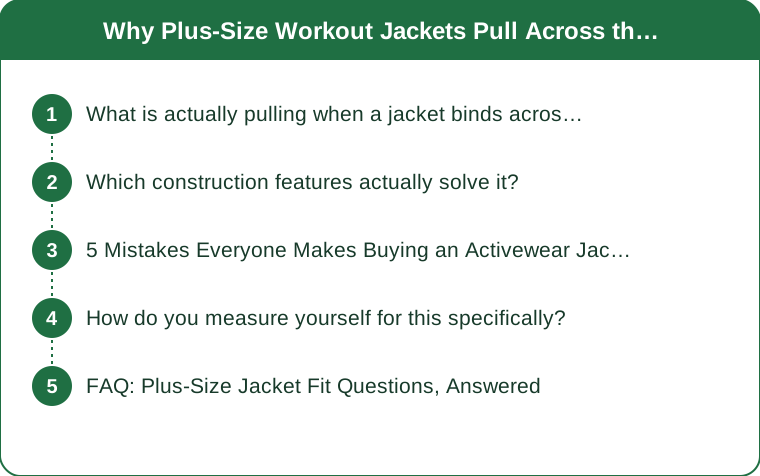
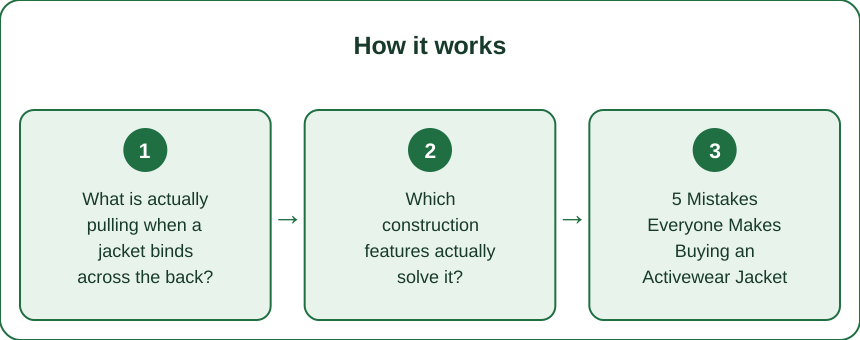
What is actually pulling when a jacket binds across the back?
Reach your arms forward and your shoulder blades separate and rotate outward. That movement increases the distance across your upper back by a meaningful amount - typically several inches between arms-down and arms-fully-forward.
A jacket has to absorb that expansion somewhere. It can come from stretch in the fabric, from ease built into the back panel, or from a construction that lets the armhole move. If none of those exist, the fabric goes taut across the shoulder blades and the whole garment pulls back and up.
Here is the grading problem. When brands scale a pattern up, the bust and waist measurements grow generously, because those are the numbers on the size chart that customers check. The cross-back width and the armhole depth often grow far more slowly, because those changes require re-drafting the sleeve rather than just adding width.
The result is a jacket that measures correctly at the bust, hangs loose at the waist, and still binds the instant you reach for a barbell. You are not between sizes. The pattern is disproportionate in the specific dimension you need.
This is worse in activewear than in outerwear because activewear jackets are cut close on purpose, which removes the ease that would otherwise absorb the movement.
Which construction features actually solve it?
Four things, in rough order of impact:
1. Raglan sleeves. The seam runs diagonally from underarm to collar instead of sitting on the shoulder point. This removes the fixed shoulder seam entirely and lets the whole shoulder area move. For anyone who has broad shoulders relative to their waist, raglan is transformative - it is the single most reliable feature to look for.
2. A center back seam, pleat, or vent. Any of these gives the back panel somewhere to expand. An inverted box pleat between the shoulder blades adds a couple of inches of reach room without adding bulk when you are standing still.
3. Genuine four-way stretch. Check the composition - a jacket with at least 10-12% elastane or spandex in a knit will stretch across the back. A woven shell with 2% elastane technically stretches and will still bind. Face the fabric and pull it diagonally; if it barely gives, the jacket will not either.
4. Gussets or set-in underarm panels. Less common in mainstream activewear, standard in climbing and technical apparel. A diamond gusset under the arm adds reach without changing the fit anywhere else.
Features that do not help despite looking like they should: side panels (wrong axis), a longer hem (wrong direction), and a looser overall fit (adds fabric where you did not need it).
5 Mistakes Everyone Makes Buying an Activewear Jacket
1. Trying it on with arms down. Every jacket fits standing still. Reach both arms straight forward as if pushing a door, then cross them, then raise them overhead. If the hem lifts more than an inch or the back goes tight, it is the wrong armhole for you.
2. Sizing up to fix binding. This adds width at the bust and waist, which is where you already had room. The armhole depth and cross-back grow only fractionally. You end up with a jacket that is baggy and still binds.
3. Ignoring the sleeve when the problem is the back. These are the same pattern piece. A sleeve that feels tight at the bicep is often the same drafting issue showing up one seam over.
4. Buying a jacket you can only wear zipped. Many plus-size jackets are drafted assuming the zip is closed, which loads the back panel differently. Try it both ways - open is how you will actually wear it half the time.
5. Judging the fabric by hand feel instead of stretch direction. A soft fabric that only stretches horizontally will bind on the diagonal, and diagonal is exactly the direction the back expands. Pull the swatch corner-to-corner in the store, not side to side.
How do you measure yourself for this specifically?
The measurement almost nobody takes is the one that matters.
Cross-back width: stand naturally with arms down. Have someone measure straight across your upper back from the outer edge of one shoulder joint to the other, at armpit level or slightly above. That number, not your bust, predicts whether a jacket will bind.
Armhole depth: measure from the top of the shoulder straight down to the armpit crease. Deeper armholes allow more reach; shallow ones bind fast.
The reach test measurement: measure your cross-back with arms down, then with arms extended fully forward, and note the difference. Most people see 3-5 inches of expansion. That is the amount of stretch or ease a jacket needs to accommodate.
Using this when shopping online: many brands publish a flat-measurement chart in addition to the body chart. Compare the garment’s back width to your arms-down cross-back and look for at least an inch or two of ease if the fabric has minimal stretch, or a close match if it is a high-elastane knit.
If a brand only publishes bust, waist, and hip, that tells you something too - it usually means they graded on those three numbers and everything else scaled proportionally, which is exactly the problem.
FAQ: Plus-Size Jacket Fit Questions, Answered
Is a men’s jacket a good workaround for broad shoulders?
Sometimes, and it is worth trying. Men’s patterns generally have wider cross-back and deeper armholes at the same chest measurement. The trade-offs are a straighter waist and a longer sleeve. For a training jacket rather than a fitted layer, this often works fine.
Should I get a jacket altered?
Back width is one of the harder alterations because it requires re-cutting the armhole and sleeve. Shortening sleeves or taking in the waist is easy and cheap; adding back room is neither. Buy for the back and alter everything else.
Why does the same brand fit differently across two jackets?
Different patterns, often different factories, and frequently a different fabric with a different stretch percentage. Composition on the label tells you more about how a jacket will move than the size on the tag does.
Do half-zips fit differently from full-zips?
Yes - a half-zip has a continuous fabric panel across the lower back and front, which can actually reduce give. Full-zips let the front open and redistribute tension. If you are between the two and reach matters, full-zip is usually the safer choice.
TL;DR:
- Binding across the back is an armhole and cross-back grading issue, not a size issue.
- Look for raglan sleeves, a center back seam or pleat, and 10%+ elastane.
- Measure your cross-back, arms down and arms forward, and shop against garment flat measurements.
- Do the reach test in the fitting room every single time, zipped and unzipped.
Once you know the two measurements that actually predict fit, the guesswork mostly disappears - and you stop buying jackets a size up to solve a problem that size was never going to fix.
See It in Motion
Seen here: UPF 50+ Short Sleeve Rashguard Swim Shirt — shop it on bubblelime.com
Keep Reading
This article is for general informational and styling purposes only. Fit, sizing, and product availability may vary.