Why Plus-Size Sports Bras Dig at the Shoulders and the Fix
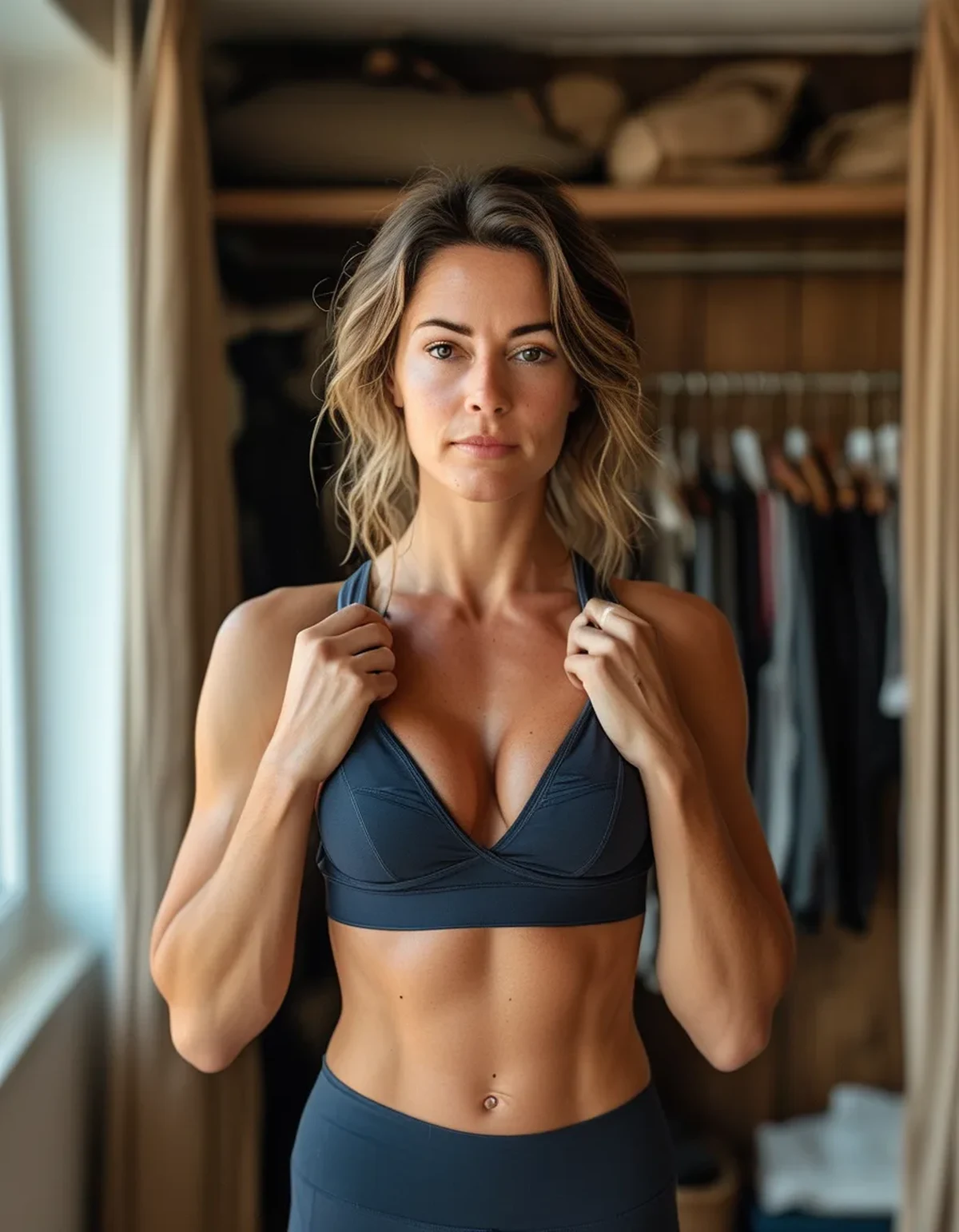
Quick Answer: If your sports bra straps dig, the band is almost certainly too loose. The band should carry roughly 80% of the support; when it rides up or has too much give, that load transfers to the straps and concentrates on a narrow area of shoulder. The fix is a tighter band, not looser straps.
It is the most consistent fitting error in the category, and it is one of the few where the solution feels wrong until you try it.

Why is the band doing most of the work?
A well-fitted bra is a system where the band around the ribcage provides the majority of the support — commonly cited as around 80% — and the straps provide the remainder, mostly stabilising rather than lifting.
That distribution exists because the band works in tension all the way around the torso, spreading load across a large surface area. Straps work in compression on two narrow strips of shoulder, and the trapezius underneath is not designed to carry sustained downward load.
When the band is too loose, the system reallocates. The weight has to go somewhere, and it goes to the straps. You then feel it as a strap problem — digging, red marks, aching between the neck and shoulder after a run — and the instinct is to loosen the straps, which transfers even more load to a band that already cannot hold it.
That feedback loop is why the problem persists through several bras.
How do you know the band is too loose?
Four tests, quick to run:
-
The back should be horizontal. Look in a mirror. If the band rides up your back in a curve, it is too loose. This is the clearest single indicator.
-
Two fingers, no more. You should be able to slide two fingers under the band with resistance. If your whole hand fits comfortably, size down in the band.
-
The bounce test without straps. Slip the straps off your shoulders and jump. A correctly fitted band still provides noticeable support on its own. If everything drops, the band is not doing its job.
-
Loosen the straps fully and check. If the bra becomes useless with loose straps, they were carrying the load.
The common correction is a band size down and a cup size up — a 42D often becomes a 40DD. The volume stays the same, the support moves to where it belongs. This is where most people balk, because a tighter band sounds less comfortable and turns out to be more.
5 Mistakes Everyone Makes with Sports Bra Fit
1. Buying by dress size. Sports bras sold in S/M/L cannot account for band and cup independently, which is exactly the variable that matters. Where a band-and-cup sizing option exists, use it.
2. Wearing it on the loosest hook from day one. Start on the loosest and tighten as the elastic relaxes. Starting on the tightest means the bra has nowhere to go after two months.
3. Keeping it for years. Band elastic degrades. A regularly worn sports bra typically has a useful life measured in months, not years, and the failure is gradual enough that you do not notice it.
4. Assuming wider straps solve digging. Wider straps distribute load better and are genuinely helpful, but they treat the symptom. If the band is wrong, wide straps just spread the same problem.
5. Ignoring the impact level. A compression bra that works for walking is under-specified for running, and the deficit shows up as strap load — the fifth one catches people who upgraded their training without upgrading their gear.
What features actually matter at higher support levels?
Once the band is right, these make a real difference:
-
Encapsulation over compression. Compression bras flatten against the chest; encapsulation bras have separate structured cups. For larger busts, encapsulation consistently outperforms — and combination designs do both.
-
A wide, firm underband. More surface area means lower pressure per square inch and less riding up.
-
Adjustable straps that adjust at the back, not just the front. Back adjustment lets you change strap length without changing the angle across the shoulder.
-
A racerback or convertible option. Racerback pulls the strap load inward toward the centre of the trapezius, which many people find substantially more comfortable than parallel straps.
-
Front closure or hook-and-eye at the back. A step-into bra with no closure has to be loose enough to pull over your head, which caps how firm the band can be. This is a structural limit, not a fit issue.
How do you make it last?
Band elastic is the component that fails, and nearly all of the damage is preventable.
Wash cool, and never in hot water. Heat destroys elastane faster than anything else.
Never tumble dry. This is the single largest cause of premature band failure.
Rotate at least two bras. Elastic needs 24 hours to recover its shape. Wearing the same bra daily roughly halves its life.
Wash after every two or three wears at most — sweat and body oils degrade elastane, so washing regularly is preservation rather than wear.
Do not hang by the straps when wet. The weight of the water stretches them permanently. Lay flat.
Replace when the loosest hook stops being usable. When you are on the tightest hook and it still rides up, the bra is finished regardless of how it looks. Most people get 6-12 months from a regularly worn sports bra, and treating that as normal rather than as a disappointment makes it easier to replace on time.
TL;DR:
- The band carries around 80% of the support; digging straps almost always mean a loose band.
- Check that the back band is horizontal, allows only two fingers, and supports you with the straps off.
- The usual correction is a band size down and a cup size up, keeping volume the same.
- Encapsulation, a wide underband, back-adjustable straps, and a real closure all matter at higher support levels.
- Wash cool, never tumble dry, rotate two bras, and expect 6-12 months of life.
If you have been loosening straps for years and wondering why nothing helps, this is the reason. The fix feels counterintuitive for about ten minutes and then feels obvious.
See It in Motion
Seen here: Racerback Tank Top - White — shop similar styles on bubblelime.com
Keep Reading
This article is for general informational and styling purposes only. Fit, sizing, and product availability may vary.