The Seam Placement Guide for Plus Size Activewear
Quick Answer: In plus size activewear, seam placement matters more than fabric weight or size selection. The three that determine comfort are the inner thigh seam (a flat gusset instead of a crossing seam prevents most chafing), the side seam (a curved seam follows the body better than a straight one), and the waistband join (a bonded or wide-elastic join avoids the ridge that digs when seated). Check these three before anything else.
Two leggings in the same size, same fabric, same brand line. One is comfortable for eight hours and one is unwearable after twenty minutes.
The difference is almost always where the seams are.
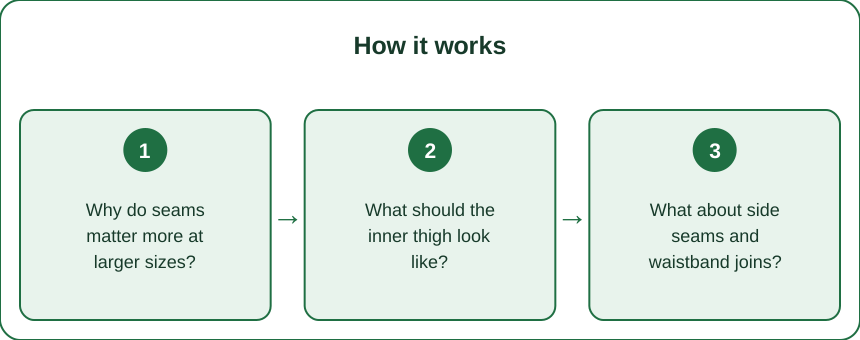
Why do seams matter more at larger sizes?
Because the same seam covers more distance and crosses more movement.
Seams are the least stretchy part of any garment. Stitching restricts the fabric’s ability to extend, which means every seam is a line of reduced stretch running across a body that needs to move. The longer that line, the more it can restrict.
Grading amplifies placement errors. Most patterns are drafted at a mid-size and graded up and down from there. Grading scales dimensions, but body proportions do not scale uniformly - thigh circumference, hip-to-waist ratio and inseam length all change at different rates. A seam that sits in a neutral position at a size 10 can land directly on a friction point at a size 20.
Contact points change too. Where the inner thighs make contact and how much surface area is involved differs substantially across sizes, which means a seam running through that zone has considerably more opportunity to cause friction.
And there is more heat and moisture. A seam in a high-contact area holds moisture and creates a raised ridge - the two conditions that produce chafing. In late summer humidity this is at its worst, which is why chafing complaints spike in August and September.
The takeaway for shopping: fabric quality is the thing brands market and seam placement is the thing that determines whether you wear the garment. You can assess placement in about thirty seconds if you know where to look.
What should the inner thigh look like?
This is the single highest-impact area, and there are three constructions.
The worst: a single seam running down the inner leg with a crossing seam at the crotch. Four seam lines meeting at one point creates a bulk node exactly where friction is highest. This is common in cheaper construction and is the most reliable predictor of chafing.
Better: a diamond gusset. A separate diamond-shaped panel at the crotch moves the seam intersections away from the centre, distributing them into four shorter seams around the panel rather than one bulky junction. This is a meaningful improvement and is now common in mid-range activewear.
Best: a flat-locked or bonded gusset. Flatlock stitching produces a seam with no raised ridge on either side, and bonded construction eliminates stitching in that area entirely. Either dramatically reduces friction.
How to check in a shop: turn the leggings inside out and run a finger along the inner thigh seam. If you can feel a raised ridge, you will feel it against your skin. If it is flat and smooth, it will likely be fine.
Also check where the seam sits vertically. A gusset that sits too far forward or back pulls the whole garment out of alignment, which produces twisting during wear even if the seam itself is flat.
A related point on fabric in that zone: the inner thigh is where most leggings pill and thin first. A garment with good seam construction but thin fabric in that area will still fail - hold the inner thigh up to light and compare its opacity to the outer thigh. If it is noticeably more sheer, it is thinner there and will wear through faster.
What about side seams and waistband joins?
Both change comfort substantially and are easy to assess.
Side seams: curved beats straight. A straight side seam assumes the distance from waist to hem is the same on the outside of the leg as on the inside, which is not true for most bodies and becomes less true at larger sizes. The result is twisting - the side seam migrates toward the front or back during wear.
Curved or contoured side seams follow the actual silhouette, and panelled construction with multiple curved sections follows it better still. The rule of thumb: more panels usually means better shaping, at the cost of more seams.
Some leggings have no side seam at all, which is generally excellent for comfort. The trade-off is less shaping, so they may fit less precisely at the waist and hip.
Waistband joins: look for width and flatness. The join where the waistband meets the body of the legging is a horizontal seam sitting at exactly the height where a seated position creates pressure.
What works:
- A wide waistband - more than about 10cm - distributes pressure rather than concentrating it
- A bonded or flatlock join with no raised ridge
- Continuous fabric where the waistband is formed from the same piece, folded rather than joined
What does not:
- A narrow elastic in a casing, which creates a distinct pressure line
- A join with a serged edge on the inside, which is the ridge you feel after two hours in a chair
The seated test applies here too. Sit down in the fitting room and stay sat for a few minutes. The waistband join either disappears or announces itself, and it will not change once you get home.
What Nobody Tells You About Plus Size Activewear Construction
Five things that change how you shop.
Extended sizing and true plus sizing are different things. A brand that grades its standard pattern up to a 3X is doing something different from a brand that drafts a separate block for larger sizes. The second produces far better proportions, and it is worth finding out which you are buying. Brands that draft separately usually say so - it is a selling point.
The inner thigh is the wear indicator for the whole garment. If it thins or pills within a few months, the fabric was too light for the friction it faces regardless of how the rest looks. Check that area on any garment you have owned a while - it tells you what that brand’s fabric actually does.
Compression and support are not the same as tightness. A well-constructed garment can feel supportive without pressure points, because the support comes from fabric recovery and panelling rather than from simply being small. If support only arrives with digging, the construction is doing the work the wrong way.
Squat-proof claims are about fabric weight and knit density, not size. The same fabric that is opaque at a smaller size can sheer at a larger one because it is stretched further. Testing in the fitting room under actual light is the only reliable check - and it is a fabric issue rather than a body issue.
Pockets change seam geometry. A side pocket adds a substantial seam structure to the outer thigh, which can help by adding a panel or hurt by adding bulk. Loaded pockets also drag the waistband down on one side, which is worth testing with your phone actually in it.
FAQ: Plus Size Activewear Fit Questions, Answered
Why do my leggings twist as I walk?
Usually a straight side seam on a body that needs a curved one, or a gusset positioned slightly off-centre. Neither is fixable after purchase. Look for contoured side seams or seamless construction next time.
How do I stop inner thigh chafing?
Start with construction - a flatlock or bonded gusset removes most of the friction source. Beyond that, a longer inseam that keeps fabric between the contact points works better than a short one, and an anti-chafe balm handles the rest.
Is squat-proof the same across sizes?
No. The same fabric stretches further at a larger size, so opacity can differ between sizes of the same product. Always test under bright light rather than trusting the product page.
Should I size up if the waistband digs?
Not usually. Digging is generally a construction issue - a narrow band or a ridged join - and sizing up creates sliding instead. Look for a wider waistband with a bonded join in your normal size.
Why do the inner thighs wear out first?
That area faces the most friction and often uses the same fabric weight as lower-friction areas. Washing inside out in cold water and air drying extends life, but a brand that consistently fails there is using fabric that is too light for the application.
TL;DR:
- Seam placement determines plus size activewear comfort more than fabric or size
- Inner thigh: look for a flatlock or bonded gusset, not four seams meeting at one point
- Turn the garment inside out and feel for raised ridges before buying
- Side seams should be curved or absent - straight seams twist during wear
- Waistband joins should be wide and flat; sit down for a few minutes to test
- Brands that draft a separate block for larger sizes fit better than those grading up, and usually say so
The fabric is what gets marketed. The seams are what you actually live with.
See It in Motion
Seen here: High Waist Yoga Leggings with Side Pockets — shop it on bubblelime.com
Keep Reading
This article is for general informational and styling purposes only. Fit, sizing, and product availability may vary.